


The Assignment
I was sent to Miami with instructions so vague they bordered on reckless.
“Find out what it really is now,” they told me. “Strip away the brochure.”
There was no list of attractions, no curated schedule — just the city and whatever it chose to reveal.
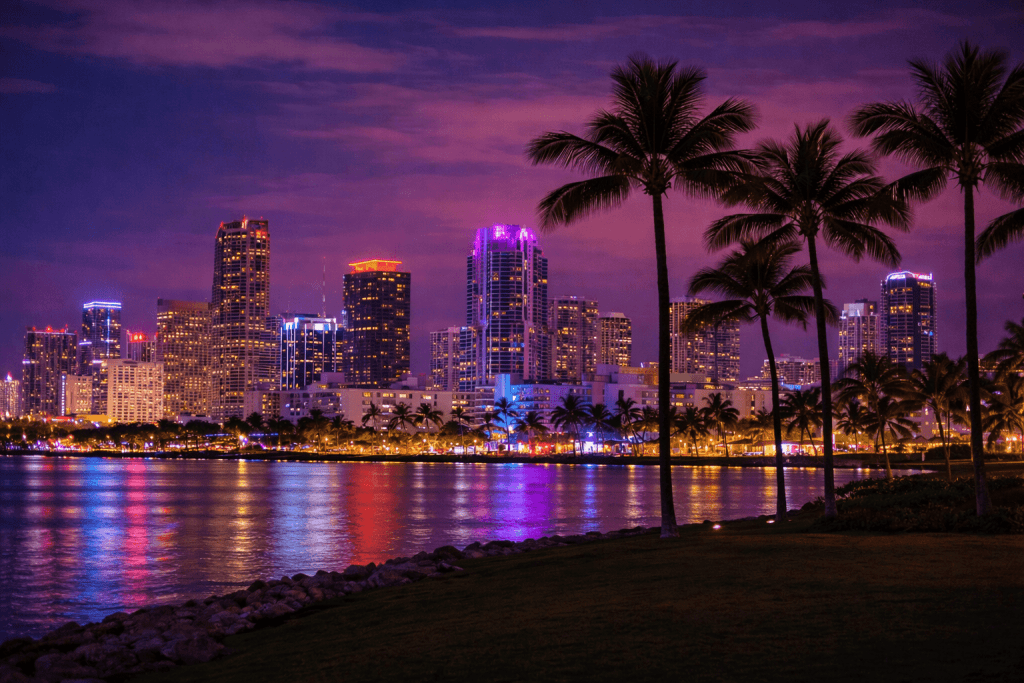
I arrived just before sunset, the sky violet and excessive. The air pressed in close, humid but deliberate, like it was assessing me. Miami doesn’t welcome you immediately. It studies you first.
I left my bag in the Design District — glass façades, sculpted palms, white pavement reflecting heat back at you like a challenge. The storefronts were immaculate, conversations lower in volume but higher in consequence. Even the coffee shops felt engineered, as though spontaneity had been carefully approved by committee.
The café sat between a gallery that sold furniture like sculpture and a boutique that displayed handbags as if they were archival artefacts. Outdoor tables arranged with geometric precision, shade provided by trees that looked consulted.
I chose the seat with a view of the street.
That illusion of control lasted fourteen minutes.
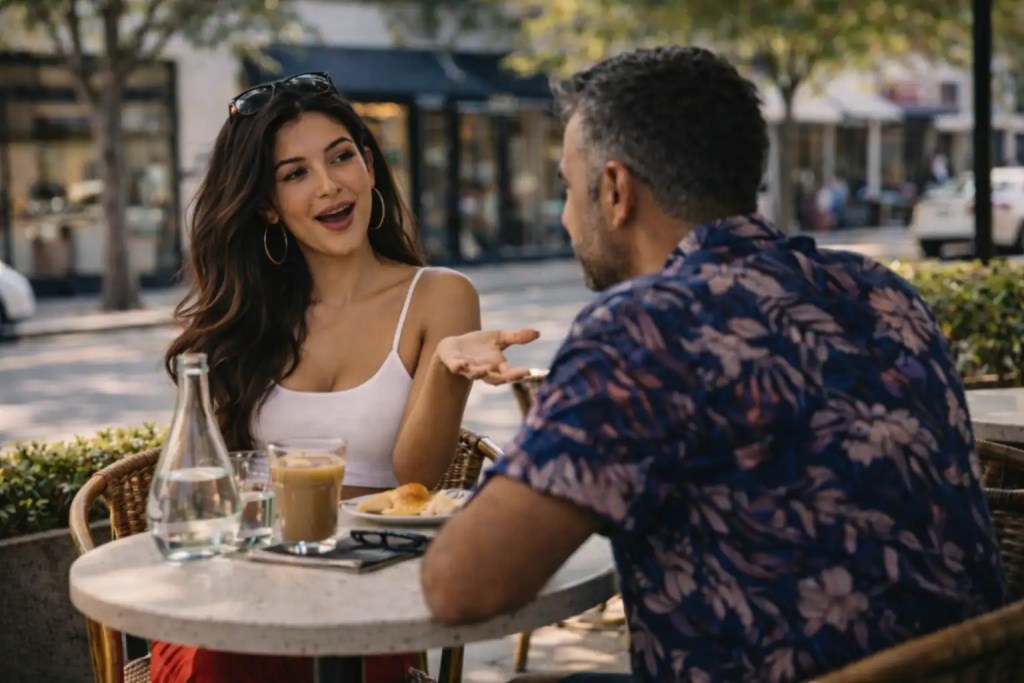
She took the chair opposite without asking — red trousers, dark hair, sunglasses pushed into her hair like punctuation.
“You look like you’re waiting,” she said.
“I’m working.”
“On what?”
“Miami.”
That earned a pause.
“You won’t find it in here.”
Two others drifted over as if the conversation had already been underway. A man with a gold chain and the posture of someone who never rushes. A woman who scanned the room before committing to a word.
“Wynwood’s different now,” the man said, as if I’d asked.
“Only if you don’t look properly,” she replied.
“There’s a warehouse Thursday,” Camila said. “Design District’s too polished. Wynwood’s where it still breathes.”
“Downtown’s where it pays,” the quiet woman added.
No one explained any of it. They didn’t need to.
Camila stood mid-sentence and walked out without touching the bill. The espresso cups remained, cooling in disciplined silence.
Mateo glanced at me. “You coming or not?” I left a sweaty note on the table, closed my notebook and followed.
Miami owed me a cup of coffee and a muffin.

The Exhibition
Thursday arrived without ceremony.
The address Camila sent led to a warehouse with a half-open door and light leaking onto the pavement. A line formed without admitting it was a line — people angled casually toward entry while pretending they had somewhere else to be.
Inside, the air felt temporary. Steel frames. Projection mapping crawling across raw walls. Canvases hung without labels, as if daring you to misinterpret them. Nothing permanent. Nothing framed. You had to ask questions, which meant you had to talk.
Camila moved through the room like she’d designed it but refused credit. Mateo leaned against the back wall, watching rather than participating. Lila disappeared into conversations and reappeared precisely where tension began to build.
It wasn’t a gallery. It was a pressure chamber disguised as one.
A man in a linen suit — too crisp for the humidity — lit a cigar in the middle of the room as though he’d purchased the oxygen.
The smoke rose, theatrical and unnecessary.
The alarm followed seconds later.
Not a polite warning — a full mechanical scream that tore through projections, music, and curated indifference.
No one panicked. We spilled into the street laughing, irritated and exhilarated in equal measure.
“All good things…” Camila said, already moving. “Now it gets interesting.”

The Rooftop
The party wasn’t announced. It assembled itself.
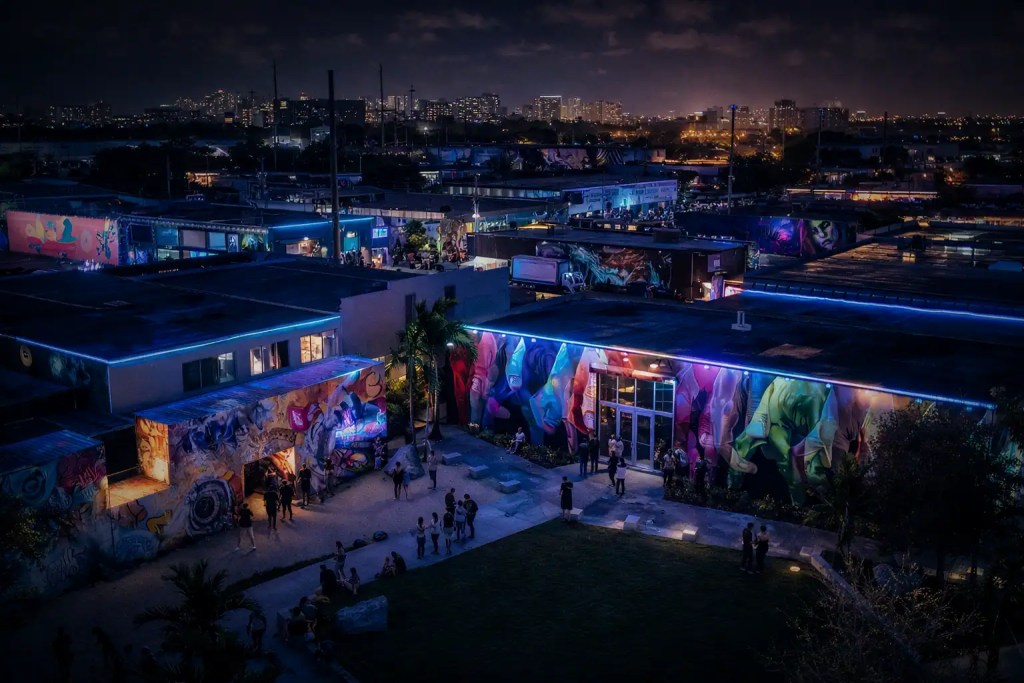
From the rooftop, Wynwood below us looked electric. Murals pulsed under streetlights like they were still wet. Cars slid through narrow streets with deliberate slowness, aware they were being watched. Music drifted upward in fragments — bass first, then laughter, then nothing.
From above, the whole neighbourhood resembled a controlled experiment: colour contained within concrete lines, chaos boxed into tidy blocks. A delivery truck idled at the corner for twenty minutes without moving, engine humming like it was awaiting permission.
Near the edge, a man stood alone with a drink he wasn’t drinking.
Open Hawaiian shirt — dark florals, one button too many undone — a thin gold chain resting against his collarbone. He wasn’t watching the party. He was studying the street.
It was the thousand-balcony stare.
I’ve seen it before — that expression men wear when they’ve mistaken height for clarity. The belief that distance equals understanding. That if you stand above something long enough, the world will arrange itself into coherence.
It rarely does.
He blinked once, slow, then drank — a long, deliberate swallow. The street had delivered its verdict, and he didn’t like the taste.
Behind me, laughter rose too sharply as a bottle struck the metal railing with a dull ring before the bass swallowed it whole. Below, the delivery truck’s engine cut out, the mechanical hum draining from the block and leaving a pocket of silence before another engine turned over somewhere in the dark.
The rhythm never faltered.
The street didn’t care who was watching.


The Morning
The text came at 6:07am.
“Biscayne. Now.”
The light over Biscayne Bay was pale and metallic when I reached the promenade, the skyline still soft in early glare. Cargo ships rested in the distance like patient witnesses. The air carried salt, diesel, and the first pull of espresso from a kiosk just beginning its day.
Mateo was already stretching near the railing that separates city from water.
I was considering retreat when I heard heels on concrete.
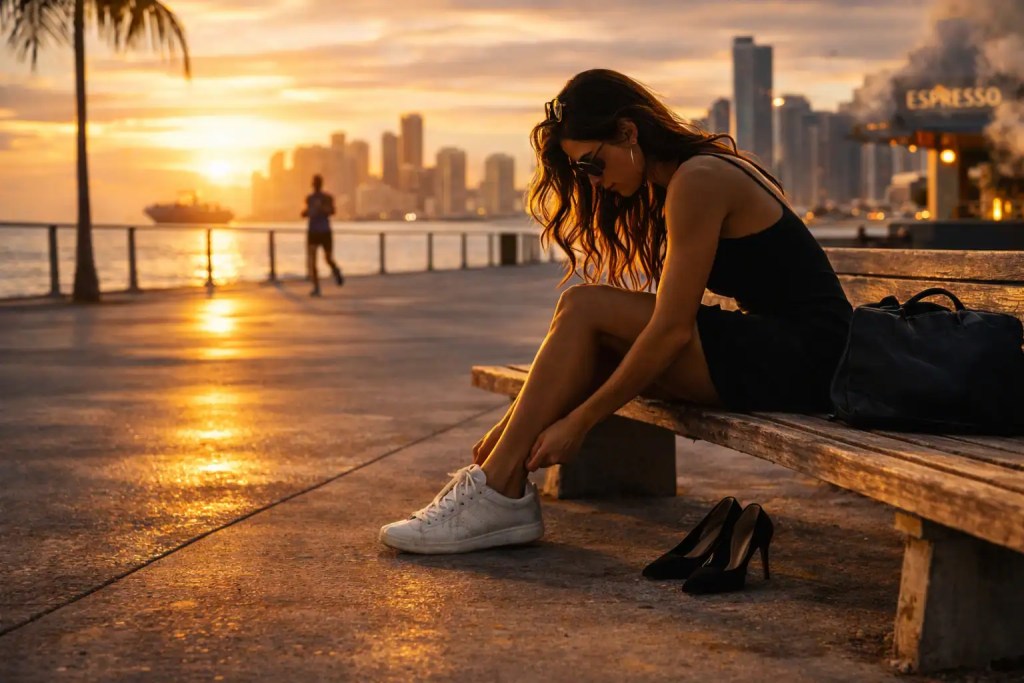
Camila appeared in last night’s black dress, sunglasses still in place, as if the evening hadn’t officially ended. She unlocked a small silver hatchback and climbed inside.
The stage show began.
Through the glass I caught fragments — her head disappearing below the dashboard, one leg appearing against the door, an elbow knocking the steering wheel. Trainers followed. A grey T-shirt. An elastic band between her teeth.
We were just missing a top-hat-wearing man with a saw and a mildly concerned assistant. A minute later the door opened and she stepped out in running gear, the black dress folded on the back seat, neatly divided from the night.
We ran south with the bay on our right and the skyline at our backs. The first stretch felt punitive. Around us, runners moved with steady discipline — no theatrics, just rhythm.
There are cities that forgive you for staying up.
Miami audits you at sunrise.

The Goodbye
We didn’t speak much after the run.
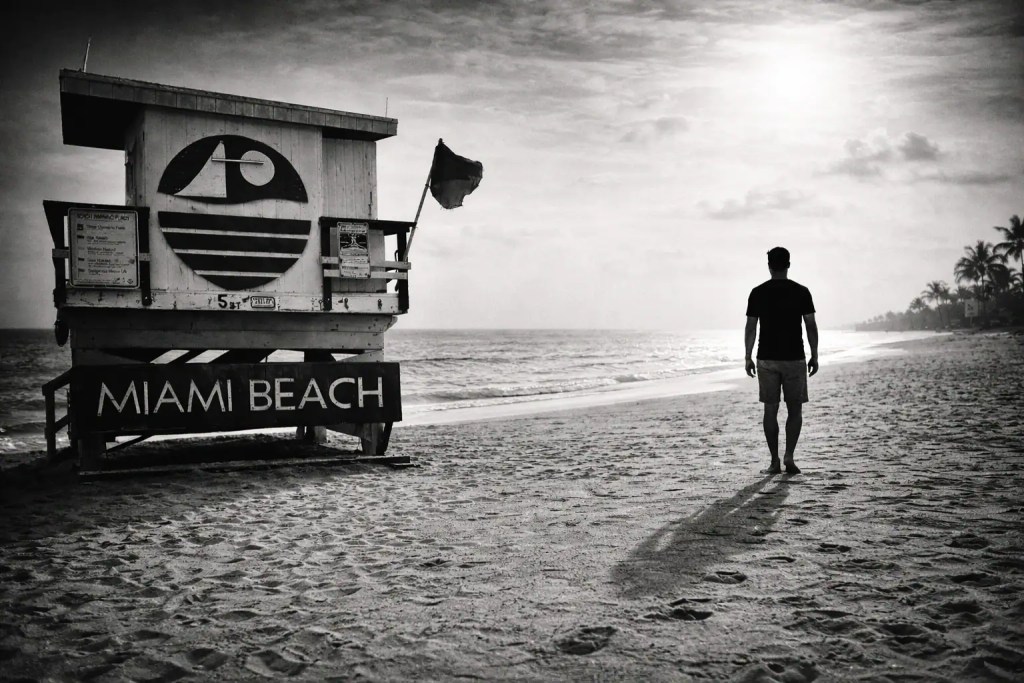
Later that afternoon, we drove east across the causeway toward South Beach, the skyline shrinking behind us until it felt like a model someone had carefully arranged and then forgotten. The Art Deco façades along Ocean Drive looked theatrical in daylight, frozen in a kind of curated nostalgia. The sand burned under a white sun, etching its memory somewhere deeper than intended.
Camila carried her heels in one hand.
“This wasn’t my Miami,” she said, nodding toward the pastel hotels. “We’d come once in a while. My mother would pack food in a cooler. We’d park as close as we could and pretend we lived over there.”
She gestured toward the buildings facing the water. For a moment, something unguarded returned to her eyes — the childlike innocence we learn to lock away.
My time in Miami was coming to an end. I felt it in the salt-thick air, in the way the light clung to the pastel facades like it could stop the world from turning. The city would keep its secrets — countless stories sweating behind shuttered windows, deals struck over cafecito, dreams inflated and punctured in the same afternoon.
I could almost see another version of myself rooted here — older, sun-bleached and half-feral, fluent in its beautiful chaos.
He might’ve even learned to enjoy the humidity.