
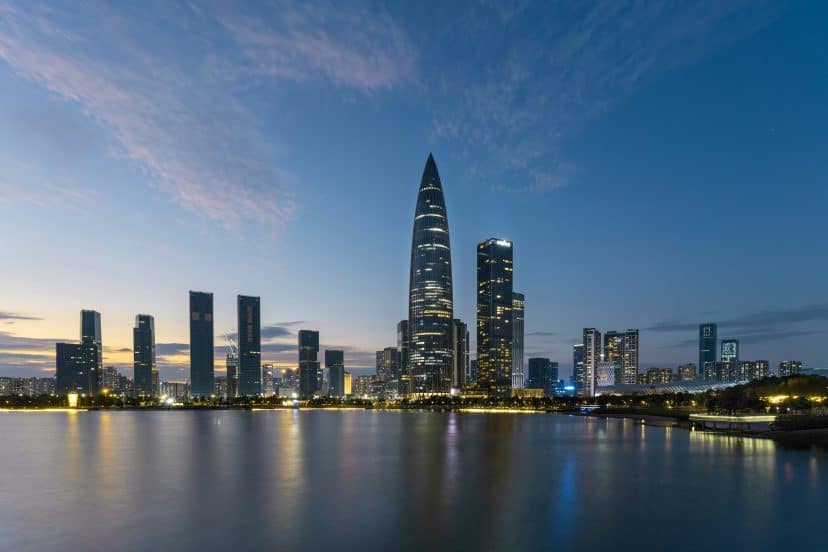






Shenzhen’s close-built urban villages offer a human-scale view of a city better known for technology, towers and relentless change.


Shenzhen at street level
Shenzhen is often introduced from afar: a bright horizon of towers, a hub of technology, a city whose pace appears to be measured in new districts, new companies and new ideas. That picture is real. It is simply not the whole city.
At street level, Shenzhen can feel much closer. In some urban villages, residential buildings rise in such close formation that windows, balconies and exterior walls face one another across the narrowest of gaps. The English phrase “handshake buildings” is often used to describe this visual intimacy: structures close enough to suggest that neighbours might reach out and shake hands. It is a memorable image, but not a literal promise or a formal planning term.
Here, the city is read at a different scale. Small businesses follow the rhythm of the day; people collect deliveries, return from work, pause for food and move through lanes shaped by years of rapid change. The close-built form is not separate from Shenzhen’s modern story. It is one of the places where that story has been lived, day after day.
For visitors arriving for meetings, trade events or a short break, this perspective can be especially useful. Shenzhen is not simply a collection of business districts joined by fast infrastructure. It is also a place of ordinary routines, long-standing communities and continuing negotiations over what growth should look like.

What are handshake buildings?
“Handshake buildings” is an informal English description associated with parts of Shenzhen’s urban villages, known in Chinese as chengzhongcun, or villages within the city. The related Chinese expression wòshǒu lóu refers to buildings packed closely together, often with little separation between facing façades.
The phrase gives visitors an immediate sense of the physical environment, but it can also flatten a complex neighbourhood into a novelty. Not every urban village has the same layout, every close-built building has the same history, or every lane produces the dramatic image implied by the term. These are lived-in residential and commercial areas, not a single architectural category.
To understand how they emerged, it helps to begin with Shenzhen’s exceptional urbanisation. As the city expanded, former villages were absorbed into the metropolis while retaining particular land, property and housing arrangements. Buildings were added and adapted in response to demand, creating dense rental accommodation above ground-floor commerce. An ethnographic account of the history of Shenzhen’s urban villages traces how these arrangements became intertwined with migration, rental income and the making of the city itself.
That history resists an easy division between a supposedly informal past and a polished future. Shenzhen’s urban villages developed alongside the city’s rise, accommodating people who came to work, build businesses and make a life in a place changing at unusual speed.
Shixia Village in Futian offers a carefully documented current example. An official 2026 social-work report describes it as an urban village where wòshǒu lóu are closely interwoven, while also focusing on local volunteer networks and community services. Read as Shixia Village, a Futian urban-village case study, it is a reminder that dense form and community life cannot be separated neatly.
“Handshake buildings” is an informal English description associated with parts of Shenzhen’s urban villages, known in Chinese as chengzhongcun, or villages within the city. The related Chinese expression wòshǒu lóu refers to buildings packed closely together, often with little separation between facing façades.The phrase gives visitors an immediate sense of the physical environment, but it can also flatten a complex neighbourhood into a novelty.

The lives held between narrow gaps
It is tempting to view close-set buildings only from above, as patterns of roofs, alleyways and blocks. On the ground, they are more practical than picturesque. A narrow lane may contain a breakfast counter, a repair shop, a convenience store, parked scooters and the steady passage of residents on their way somewhere else. Open windows carry ordinary traces of domestic life: voices, cooking, television sound, laundry and the occasional pause between errands.
Urban villages have historically formed an important part of Shenzhen’s rental-housing ecosystem, particularly during decades of inward migration. That does not justify broad claims about current affordability, nor does it mean every resident has the same experience. Conditions, rents and redevelopment pressures vary considerably by area and household. What can be said is that housing in these neighbourhoods has been connected to Shenzhen’s capacity to receive people seeking work and opportunity.
There is agency in this landscape, too. Residents are not merely the human backdrop to an unusual streetscape, and village communities are not frozen remnants waiting to be replaced. Shops, landlords, tenants, delivery workers, volunteers and local service providers all shape neighbourhood life. In Shixia, the official report’s attention to volunteer participation and delivery activity gives a more useful picture than an architectural shorthand ever could: a dense district sustained by relationships and daily coordination.
The most respectful way to think about handshake buildings, then, is not as an urban curiosity. They are evidence of pressure, adaptation and proximity, but also of lives conducted with purpose in a city where space has long carried great value.
A city made at extraordinary speed
Those close quarters make more sense when set against Shenzhen’s scale. Its transformation is often summarised in sweeping terms, yet the figures remain striking. Shenzhen’s 2025 official statistics recorded 18.2485 million permanent residents at the end of the year, with 99.79% living in urban areas. The city added 259,000 permanent residents over the preceding year.
Numbers alone cannot explain the texture of a place, but they help explain why Shenzhen’s built environment contains such contrasts. A city of this scale requires workplaces, transport, schools, housing, public services and places for everyday commerce. The metropolitan skyline is one answer to that demand. The urban village is another part of the same wider history.
Former village land and settlement patterns did not simply disappear when roads, offices and apartment towers arrived around them. In many cases, they became enclosed by expansion, their built fabric evolving under conditions very different from those of master-planned commercial districts. This is why Shenzhen can shift so quickly from broad boulevards and glass façades to intimate lanes and tightly aligned apartment buildings.
Density, in other words, is not an interruption in Shenzhen’s development narrative. It is among the conditions that made rapid growth possible, and it continues to raise difficult questions about housing, infrastructure, renewal and belonging.
Tomorrow, metres away
One of Shenzhen’s defining sensations is the short distance between different urban worlds. A modern business district, metro station or new residential complex may sit close to streets whose scale feels more improvised and intensely local. The contrast is visual, but it need not become a simplistic tale of old versus new.
Many people’s days cross these boundaries without ceremony. Someone may leave a dense residential neighbourhood in the morning, travel through a highly connected city and work in an office, retail or service environment associated with Shenzhen’s contemporary economy. The city’s future-facing identity is therefore not confined to its towers, just as its older social fabric is not confined to a preserved past.
Nantou Ancient City demonstrates a different approach to renewal. The municipal housing authority describes a protection-and-use project beginning in 2019 that avoided wholesale demolition and retained existing property relationships, bringing historic fabric into contact with cultural and everyday urban uses. Nantou Ancient City’s renewal approach should not be treated as a typical untouched handshake-building district, but it shows that change need not always follow a single physical formula.
That distinction matters. Polished new construction is only one measure of progress. Better infrastructure, safer housing and improved public facilities are meaningful goals; so are continuity, livelihood and the ability for communities to remain connected to places that have supported them.
Change, redevelopment and whose city remains
Urban-village renewal in Shenzhen is active, varied and often uneven. The city’s policy framework, effective from 2024, sets out three broad routes: demolition and rebuilding, upgrading, and a combined approach. Shenzhen’s current urban-village renewal policy links renewal to living conditions and safety, while also requiring planning for public-rental and affordable-rental housing. For demolition-and-rebuilding projects, it requires consent from at least two-thirds of relevant property-right holders.
Even with that framework, outcomes are not identical from one neighbourhood to the next. A particular project may progress through signing, planning, construction and public-facility delivery at different speeds across different parcels. In Hubei, for example, a 2026 planning record confirms a permitted phase of the Hubei renewal project. That is a specific milestone, not evidence that the entire area has been cleared, rebuilt or settled.
This is where outside commentary needs humility. Renewal can bring better services, infrastructure and housing conditions. It can also alter local commerce, familiar social networks and the character of streets people know well. The available official material does not establish household-level relocation experiences or tenant outcomes for individual projects, so those should not be assumed.
The more honest conclusion is that Shenzhen’s redevelopment story remains plural. Some places are rebuilt, some upgraded, some partly transformed and some handled through more fabric-sensitive approaches. The question is not whether a city should change. Shenzhen plainly will. It is how change accounts for the people whose work, homes and routines gave its rapid ascent a human foundation.
How to look more closely as a visitor
A visitor does not need privileged access to appreciate Shenzhen beyond its skyline. Public streets, markets, cafés and established cultural spaces can reveal plenty, particularly when approached without an agenda to “discover” other people’s private lives.
- Use public routes and respect signs, staff directions and residential boundaries.
- Do not photograph into windows, homes or private spaces. China’s Civil Code includes privacy protections covering entry into, photographing or peeping into another person’s home or private space without lawful basis or express consent.
- Keep narrow lanes clear. They are working routes for residents, businesses and deliveries, not sets for staged photographs.
- Choose a meal, a small purchase or an unhurried walk over a hunt for dramatic images.
- If a local colleague or trusted contact offers context, listen first. A neighbourhood is better understood through its routines than through a single visual impression.
For corporate travellers, this may mean leaving an hour between appointments rather than treating the city solely as a sequence of meeting rooms and journeys. Shenzhen’s scale is part of its character, and moving through it attentively can offer a more durable understanding than any skyline view alone.
Staying connected to the city’s many rhythms
For longer business stays, a practical base can make room for that slower attention. Location, workspace, transport connections and the ability to reset between commitments all matter in a city this large. Readers planning accommodation can explore Still Life Global’s serviced apartments in Shenzhen for options across the city.
Shenzhen is frequently described as a place racing towards the future. Its handshake buildings complicate that phrase in the best way. They suggest that tomorrow is not only designed in laboratories, offices or towers. It is also shaped in the close quarters of everyday life: by neighbours, tenants, shopkeepers, commuters and communities finding room for one another in a city that continues to remake itself.